In any load-and-haul operation, the slowest part of the cycle sets the output of the whole fleet. Idle trucks waiting at the face and an idle excavator waiting for trucks both cost money. Fleet matching is the simple arithmetic that avoids both, and it is worth doing before you ask for quotes.
Editorial planning guidance with illustrative scenarios. No independent professional review is claimed. Read the authorship and evidence policy or report a correction.
The loading unit sets the pace
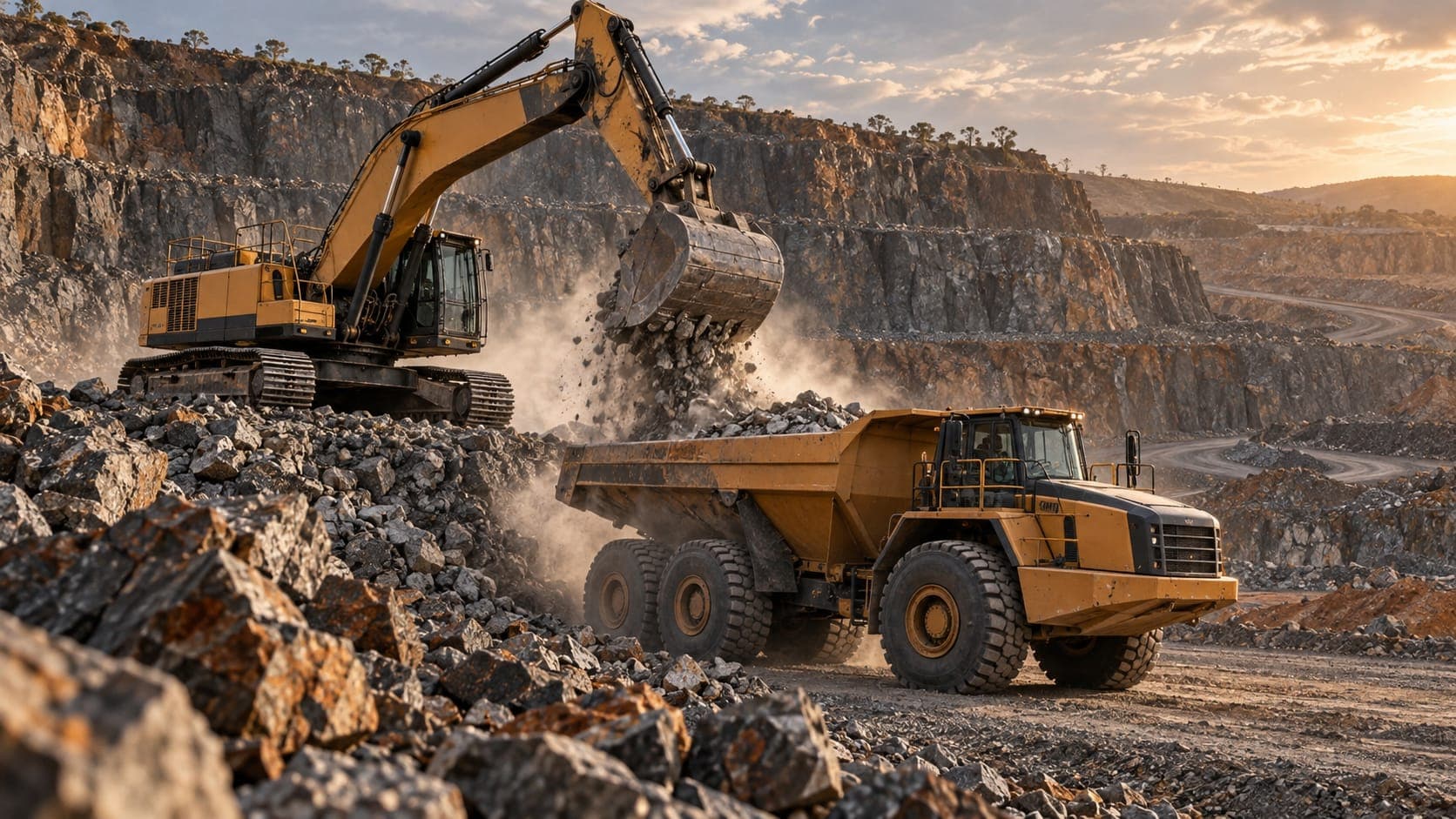
Start with the loading unit's realistic hourly output, not its brochure figure. Output depends on bucket payload (bucket capacity × fill factor for the material), swing and dig cycle time, and operating efficiency. A well-operated excavator in good digging might achieve a fill factor near 1.0; blocky rock or sticky clay can be much lower.
Pass matching
Divide the truck's payload by the bucket payload to get the number of passes. Three to five passes is a common target. Fewer passes often mean spillage and truck damage from oversize buckets; more passes mean slow truck loading. Check payload by weight as well as by volume: dense material can hit the truck's weight limit before the tray is full.
- Truck payload ÷ bucket payload = passes
- Check both volume and weight limits
- Aim for 3–5 passes for most earthmoving work
Cycle time and the number of trucks
A truck's cycle is load time + loaded travel + dump and manoeuvre + empty travel + queuing. Travel times depend on distance, grade, rolling resistance and speed limits. Once you know the cycle, the number of trucks is roughly the cycle time divided by the load time. Round up, and consider whether one extra truck is cheaper than an idle excavator.
Recalculate when haul distance changes. As a cut moves further from the fill, you may need to add trucks or change truck type part-way through the job.
Downstream plant must keep up
The dump end matters too. A dozer spreading fill, a water cart and a roller must handle the incoming volume. If they cannot, trucks queue at the dump and the whole cycle slows. Include spreading and compaction in your capacity check.
Use the maths in your enquiry
When you ask suppliers for a fleet, give the material, volumes, haul distances, grades and target daily production. Invite them to propose a matched fleet. Comparing proposals on cost per cubic metre, not just hourly rates, reveals which offer is really cheaper.
Common Australian pairings
Some excavator and truck combinations come up again and again on Australian civil jobs because they match well. A 20–25 tonne excavator with a 1.1–1.3 m³ bucket suits 6- and 8-wheel tippers and truck-and-dog combinations. A 30–36 tonne excavator with a 1.8–2.2 m³ bucket pairs well with 25–30 tonne ADTs. A 45–50 tonne excavator with a 2.8–3.5 m³ bucket matches 40–45 tonne ADTs or small rigid trucks. Pushing a 20 tonne excavator to load 40 tonne ADTs usually leaves trucks waiting.
Road-legal trucks add another variable: legal payload limits. Overloading a tipper risks fines and on-road enforcement, so for road haulage, loading to legal mass matters more than filling the tray. On-board weighing on the loader or truck helps.
| Unit | Typical payload | Where it suits |
|---|---|---|
| 6-wheel tipper | About 10–12 t | Urban deliveries, small sites, road-legal haulage |
| 8-wheel tipper | About 15–18 t | Road-legal haulage with better payload |
| Truck and dog | About 30–34 t, depending on configuration and state mass limits | Road-legal bulk haulage between sites and quarries |
| Articulated dump truck (ADT) | 25, 30, 40 and 45 t classes | Soft or steep haul roads, wet conditions, off-road only |
| Rigid dump truck (quarry) | 40–100 t | Well-built haul roads, quarries, larger civil |
| Mining haul truck | 130–360 t and above | Open-cut mines on engineered haul roads |
Productivity factors people forget
Brochure productivity assumes ideal conditions. In the field, real output is reduced by operator skill, bucket fill in sticky or blocky material, swing angle, truck spotting, poor haul roads, queuing, refuelling, pre-starts, breaks and shift change. Many estimators apply a job efficiency factor of around 45–50 minutes of productive time per hour for civil work. Wet weather, night shift and tight sites reduce it further.
Haul road condition matters as much as distance. Rolling resistance on a soft, rutted haul road can be several times that of a well-maintained compacted road, slowing loaded trucks on grades and increasing fuel and tyre wear. A grader and water cart dedicated to the haul road often pay for themselves.
- Use a realistic efficiency factor, not 60 minutes per hour
- Allow for bulking when converting bank volume to truck loads
- Recheck the match when haul distances change by more than about 20–30%
- Measure actual loads per hour in the first week and adjust the fleet
Worked example
Suppose an excavator with a 2.5 m³ bucket loads a clay with a fill factor of 0.9, giving about 2.25 m³ loose per pass. Articulated trucks carrying around 18 m³ loose would need eight passes, which is slow. A larger excavator or smaller trucks would give a better match. With a pairing that fills the truck in four passes on a 25-second cycle, loading takes under two minutes per truck.
If the truck cycle (load, haul, dump, return) is 10 minutes and loading takes 2 minutes, the excavator can keep five trucks busy. With four trucks, the excavator waits; with six, trucks queue. These figures are illustrative — use your own material, distance and machine data.
Questions to ask suppliers
To test a supplier's fleet proposal, ask:
- What bucket size and truck payload have you assumed, and how many passes does that give?
- What cycle time have you estimated for our haul, and on what road condition?
- What daily production does the proposed fleet achieve, and what is the cost per cubic metre?
- How would the fleet change as the haul distance grows?
Sample supplier brief
A short written brief gets faster, more comparable quotes. Adapt this example to your job:
“We need to move 1,200 bank m³ per day of firm clay over an average 500 m haul with a 6% ramp, on a site near Geelong, VIC. Bulking factor is about 1.3. We are open to excavator and ADT combinations.”
“Please propose a matched fleet, stating bucket size, truck payload, passes per load, estimated cycle time and daily production, and give the cost per bank cubic metre as well as hourly rates.”
Common questions
How many passes should an excavator take to load a truck?
Three to five passes is a common target for earthmoving. Check the truck's weight limit as well as tray volume, because dense material may reach the weight limit first.
Why compare fleets on cost per cubic metre?
Hourly rates ignore productivity. A more expensive but better-matched fleet can move material at a lower cost per cubic metre.
What is a fill factor?
The ratio of the material actually carried in a bucket to its rated capacity. Easy-digging loose material may exceed 1.0; blocky rock or sticky clay may be well below it.
What is rolling resistance?
The resistance a vehicle's tyres meet on a road surface, usually expressed as a percentage of vehicle weight. Soft, rutted haul roads have much higher rolling resistance than firm, well-maintained roads.
This guide is general information to help you prepare a better enquiry. It is not engineering, legal or safety advice. Equipment selection, engineering and safe systems of work remain the responsibility of competent project and supplier teams, and regulatory requirements differ between states and sites.