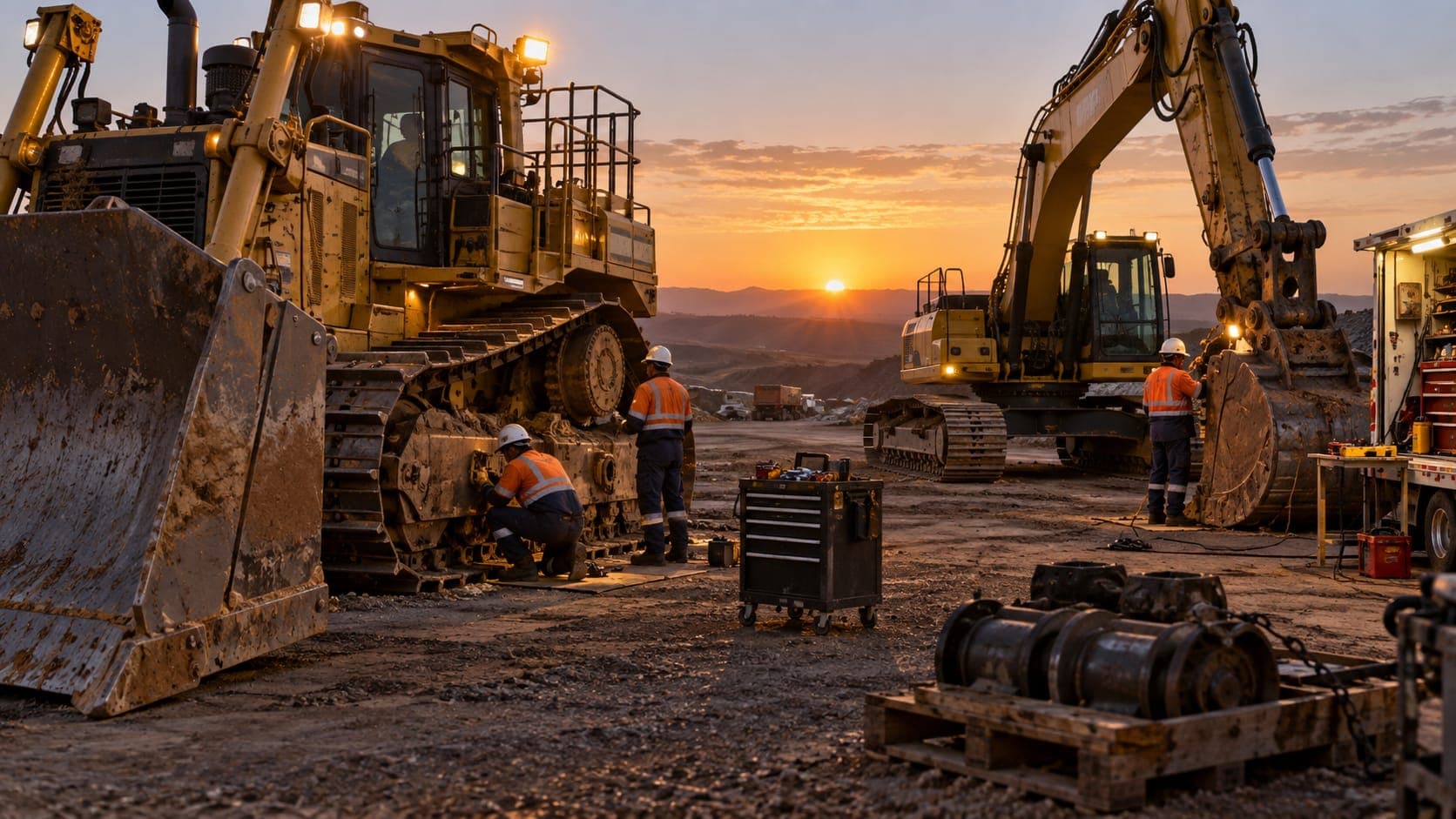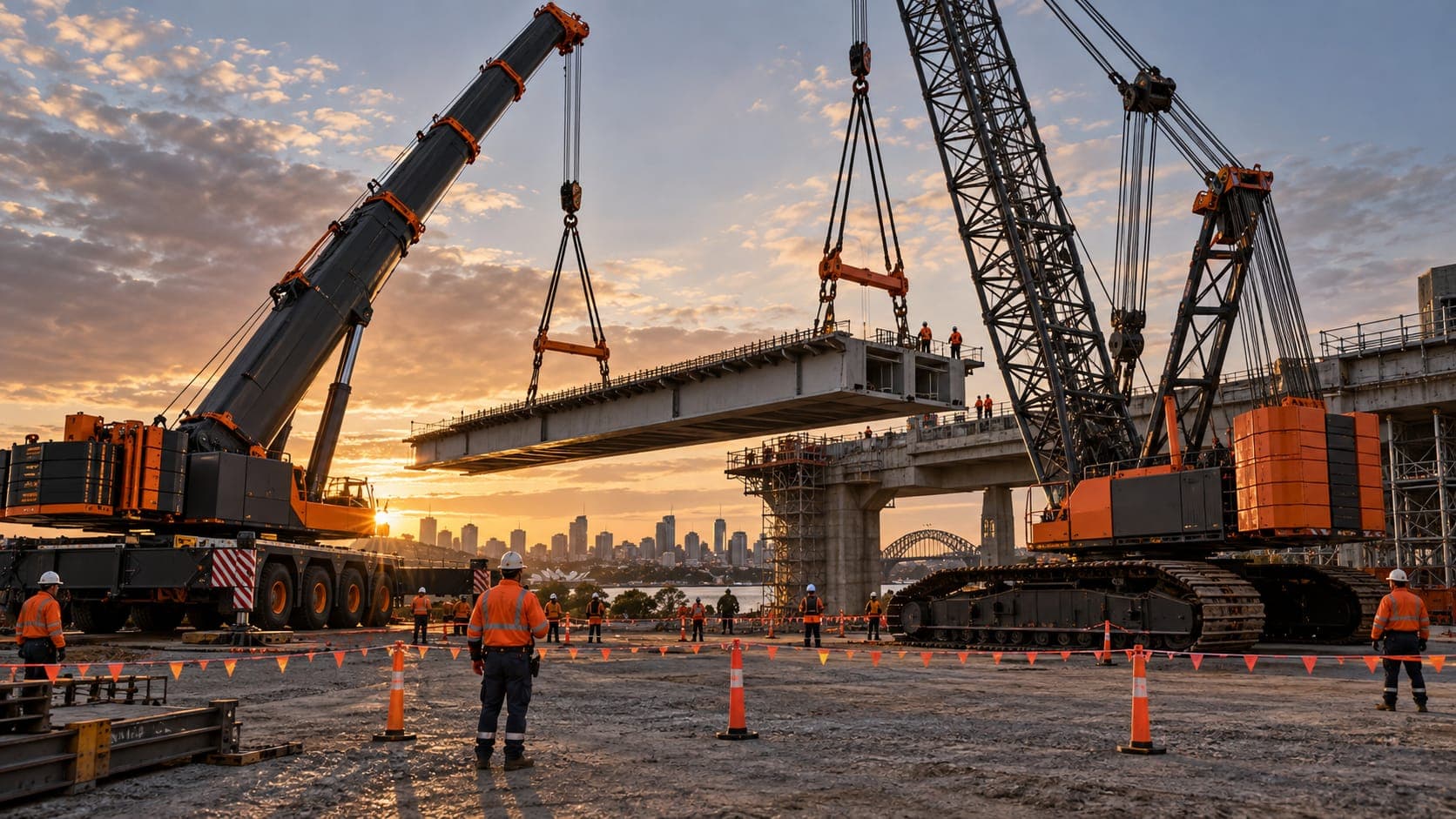
Ground failure under cranes, piling rigs and elevated work platforms is a known cause of serious incidents. The machine may be perfectly capable of the lift or task, but if the ground under an outrigger or track gives way, it can overturn. Assessing ground bearing early avoids unsafe assumptions and delays.
Editorial planning guidance with illustrative scenarios. No independent professional review is claimed. Read the authorship and evidence policy or report a correction.
Know the loads
Outrigger and track loads vary during a lift or task and can peak when the load or boom is over a particular outrigger. Crane and rig suppliers can calculate these loads for a given configuration. Ask for the maximum outrigger or track pressure for the planned work, not an average.
Know the ground
Ground capacity depends on soil type, moisture, compaction and what is underneath. Backfilled trenches, service pits, basements, retaining walls, embankment edges and recently placed fill are common weak spots. Geotechnical information or an engineer's assessment should inform the decision for heavy cranes and rigs.
- Underground services and voids
- Recent fill and trench backfill
- Proximity to excavations and batters
- Wet ground after rain
Spread the load
Outrigger pads, timber or steel mats, and crane mats spread loads over a larger area. The required pad size depends on the load and allowable ground pressure. For piling rigs and crawler cranes, a designed working platform built from compacted granular material is common practice.
Working platforms
A working platform should be designed by a competent engineer for the specific plant, built to the design, and inspected before use. Record the platform design, the plant it was designed for, and any changes. If a heavier machine or a different configuration arrives, the platform may need reassessment.
Keep checking
Ground conditions change. Rain, nearby excavation or vehicle traffic can weaken a previously safe area. Include inspection of the ground and platforms in daily pre-start checks.
Typical allowable bearing pressures
Ground bearing capacity varies enormously. A very soft clay may safely support less than 50 kPa, while dense gravel or weathered rock can take several hundred kPa or more. Compare that with crane outrigger loads: a large mobile crane can apply many tonnes through a single outrigger during a heavy lift, and even with a large mat the resulting pressure can exceed the capacity of soft or poorly compacted ground.
The table below gives rough ranges for orientation only. They are not a substitute for geotechnical advice, particularly where fill, moisture or nearby excavations are involved.
| Ground | Indicative allowable bearing pressure |
|---|---|
| Very soft clay or silt | Under 50 kPa |
| Soft clay | 50–75 kPa |
| Firm clay | 75–150 kPa |
| Stiff clay | 150–300 kPa |
| Loose sand or gravel | Under 100 kPa |
| Dense sand or gravel | 200–600 kPa |
| Weathered to sound rock | 600 kPa to several MPa |
Worked example: sizing an outrigger mat
Suppose a crane's supplier calculates a maximum outrigger load of 40 tonnes (roughly 392 kN) for a planned lift. If the ground can safely take 150 kPa, the required bearing area is 392 ÷ 150 ≈ 2.6 m², so a mat of around 1.6 m × 1.6 m would be needed at minimum — before any safety factor required by the engineer. On softer ground of 75 kPa, the area doubles to about 5.2 m², or roughly 2.3 m × 2.3 m. These numbers show why standard outrigger pads are often not enough on soft ground.
The Crane Industry Council of Australia (CICA) publishes guidance on crane ground conditions and outrigger loads that is widely used in the industry. Engineers also consider how the mat spreads load, which depends on its stiffness and thickness.
Piling rigs and working platforms
Piling rigs are tall, heavy and have high track pressures, especially when extracting casings or working at full mast height. A designed granular working platform is standard practice. The design considers the rig's worst-case loading, the subgrade strength and the platform material. The platform should be built as designed, tested and recorded, and a certificate issued before the rig works on it. Any damage or trenching through the platform needs repair and re-inspection.
Common mistakes
The most common mistake is assuming that a hard-looking surface is strong enough. A thin layer of gravel or concrete may hide soft ground, a backfilled trench, or a void underneath. Another is using outrigger pads that are too small for the load and ground.
A third mistake is not reassessing after rain or nearby excavation. Ground that was safe yesterday may not be safe today.
Questions to ask suppliers
When planning a crane or rig set-up, ask:
- What is the maximum outrigger or track pressure for this configuration and lift?
- What pad or mat size do you recommend, and do you supply them?
- Do you need a designed working platform, and who will design it?
- What ground information do you need from us?
Documenting ground assessments
Keep a record of each ground assessment: the plant and configuration it covered, the ground information used, mat or platform specifications, who approved it, and when it was inspected. If a different crane or rig arrives, or the lift changes, the assessment must be reviewed. Good records also help if an incident is investigated.
Share the assessment with the crane or rig operator before set-up, and mark the approved outrigger or track positions on the ground so the machine is set up exactly where the assessment assumed.
Illustrative scenario: a piling rig on reclaimed land
A piling contractor is installing bored piles for a new warehouse on reclaimed land near a port. The rig weighs over 60 tonnes and the site is underlain by soft marine clay.
A geotechnical engineer designs a 600 mm granular working platform over geotextile, based on the rig's maximum track pressures. The platform is built, tested and certified before the rig arrives. Later, a services trench is dug through the platform. It is backfilled, compacted and re-inspected before the rig tracks over it again.
Sample supplier brief
A short written brief gets faster, more comparable quotes. Adapt this example to your job:
“We need a 90-tonne all-terrain crane to set precast panels on a site in Newcastle, NSW. The crane will stand on a recently filled area over soft estuarine clay. Geotechnical report attached.”
“Please provide maximum outrigger loads for the planned configuration and heaviest lift, recommended mat sizes, and whether you require an engineered crane pad. Confirm who will design and certify the pad, and the inspection you need before set-up.”
Common questions
Who is responsible for checking ground bearing capacity?
Generally the person controlling the site, supported by the plant supplier's load data and an engineer where needed. Agree responsibilities before the plant arrives.
Are outrigger pads always enough?
Not always. For heavy loads or poor ground, larger mats or an engineered platform may be needed.
This guide is general information to help you prepare a better enquiry. It is not engineering, legal or safety advice. Equipment selection, engineering and safe systems of work remain the responsibility of competent project and supplier teams, and regulatory requirements differ between states and sites.