Road construction plant works as a train. Clearing and bulk earthworks feed formation, formation feeds pavement layers, and pavement feeds sealing or asphalt. A shortage at one step idles everything behind it. Planning roadworks equipment is therefore about sequencing the fleet to the construction stages and the traffic staging, not just listing machines.
Editorial planning guidance with illustrative scenarios. No independent professional review is claimed. Read the authorship and evidence policy or report a correction.
Map the fleet to the construction stages
Break the project into its stages and list the plant each needs: clearing and grubbing (dozers, excavators, mulchers), bulk earthworks (excavators, trucks, scrapers), drainage (excavators, trench shields, small loaders), subgrade and formation (graders, rollers, water carts), pavement (graders, stabilisers, pad-foot and smooth-drum rollers, multi-tyred rollers), and surfacing (profilers, pavers, rollers, sprayers).
Suppliers can then price what is needed at each stage, when, and for how long, rather than a flat list that overstates the fleet in quiet periods.
Specifications drive machine choice
Road agencies in each state publish their own specifications for earthworks, unbound and bound pavements, and asphalt. Layer thickness, density, moisture and surface tolerances determine the grader, roller weight and roller type needed. Include the relevant specification clauses and test frequencies in the enquiry so suppliers can propose machines that will actually achieve compliance.
Traffic staging and working windows
On brownfield projects the traffic management plan often sets production more than the fleet does. Night works, lane closures, speed zones and restricted access points limit how many machines can operate at once and how material is delivered. Supply the staging drawings and working windows, and ask suppliers to confirm lighting, reversing controls, and operator experience with live-traffic work.
- Night works need lighting towers and experienced night crews
- Short closure windows favour higher-output machines
- Traffic management equipment and vehicle-mounted attenuators may be separate hires
Machine control and survey
3D machine control on graders, dozers and excavators is now common for formation and pavement trim. Confirm which machines need it, who supplies the design model, and whether a site base station or network correction is available. Paver and profiler work may use string lines, sonic averaging or 3D control depending on the specification.
Regional and linear logistics
Long linear projects move the workfront daily. Plan float movements, fuel and service trucks, laydown areas and crew accommodation along the corridor. For regional highways, the distance to the nearest parts supplier and fitter can decide whether a spare machine should be on site.
How Australian road specifications shape the fleet
Each state road authority publishes its own construction specifications: Transport for NSW's QA specifications, Queensland's Transport and Main Roads MRTS series, Victoria's Department of Transport and Planning standard sections, Main Roads Western Australia's specifications and so on. They set layer thickness, compaction targets, testing lots and tolerances, and many of them prescribe the type of compaction plant or rolling pattern acceptable for a given material.
Local government roads usually follow the relevant state specification or Austroads guidance with local variations. Before asking for a fleet, identify which specification applies and share the relevant clauses: a supplier who knows that a particular granular base needs a certain roller class and testing frequency will quote more accurately.
| Machine | Common classes | Notes |
|---|---|---|
| Dozer | D4–D5 (10–13 t), D6 (about 20 t), D8 (about 38 t), D9–D11 (mining) | D6 is the typical civil class; D8 and above for ripping and heavy push |
| Grader | 12-, 14- and 16-series; 18–24 on mines | 12–14 class for civil formation and trim; 16 and up for haul roads |
| Smooth-drum roller | 10–12 t common; 15–20 t for thick lifts | Granular pavements and fill |
| Pad-foot roller | 12–20 t | Clays and cohesive fill |
| Multi-tyred roller | 10–20 t ballasted | Pavement finishing and sealing |
| Water cart | 10–15 kL truck-mounted; 20–40 kL articulated; 70 kL+ mining | Compaction moisture and dust control |
| Wheel loader | Compact to 3 m³; 4–6 m³ civil and quarry; larger mining | Stockpiles, truck loading, quarry face |
A typical road construction fleet
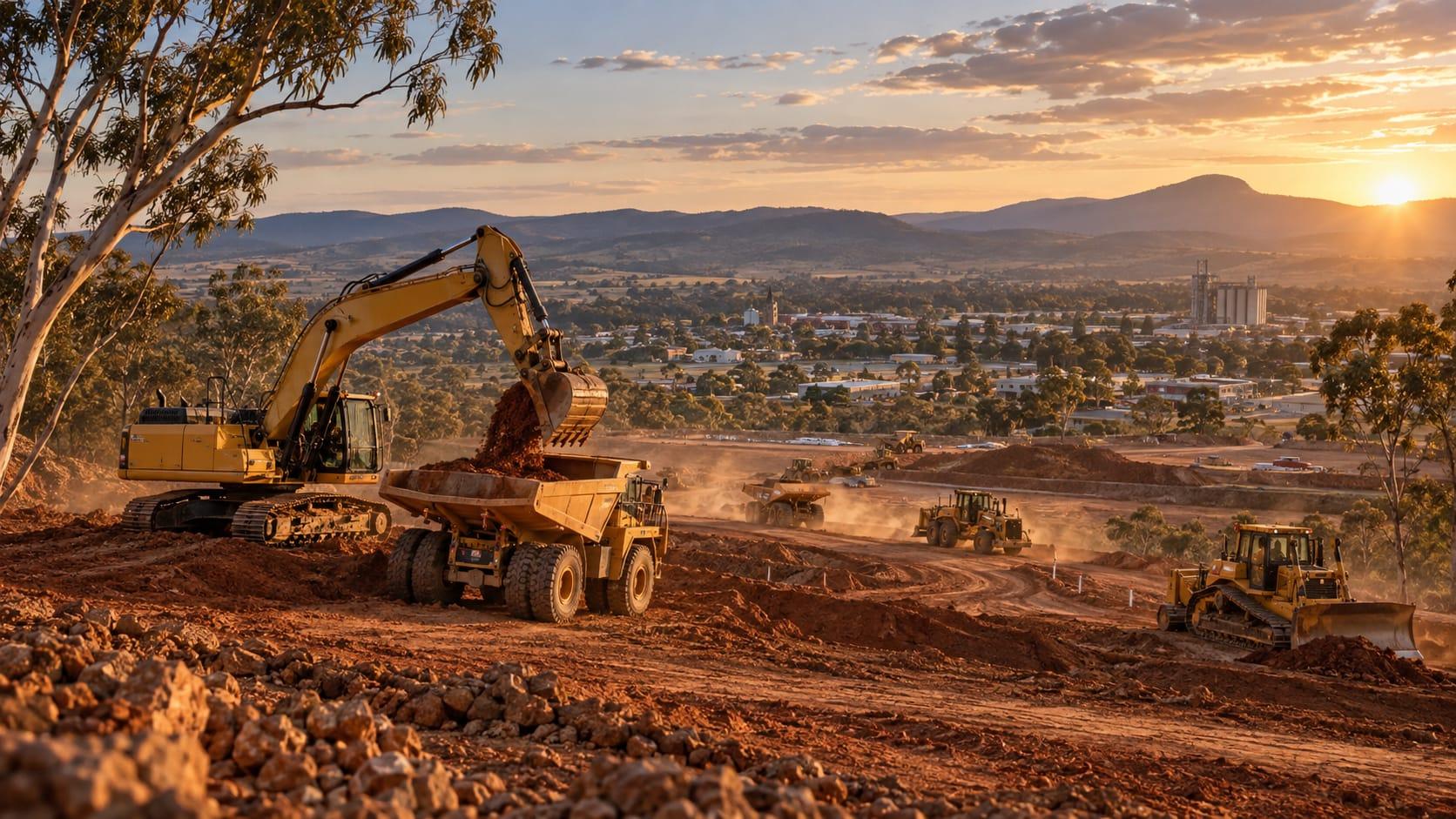
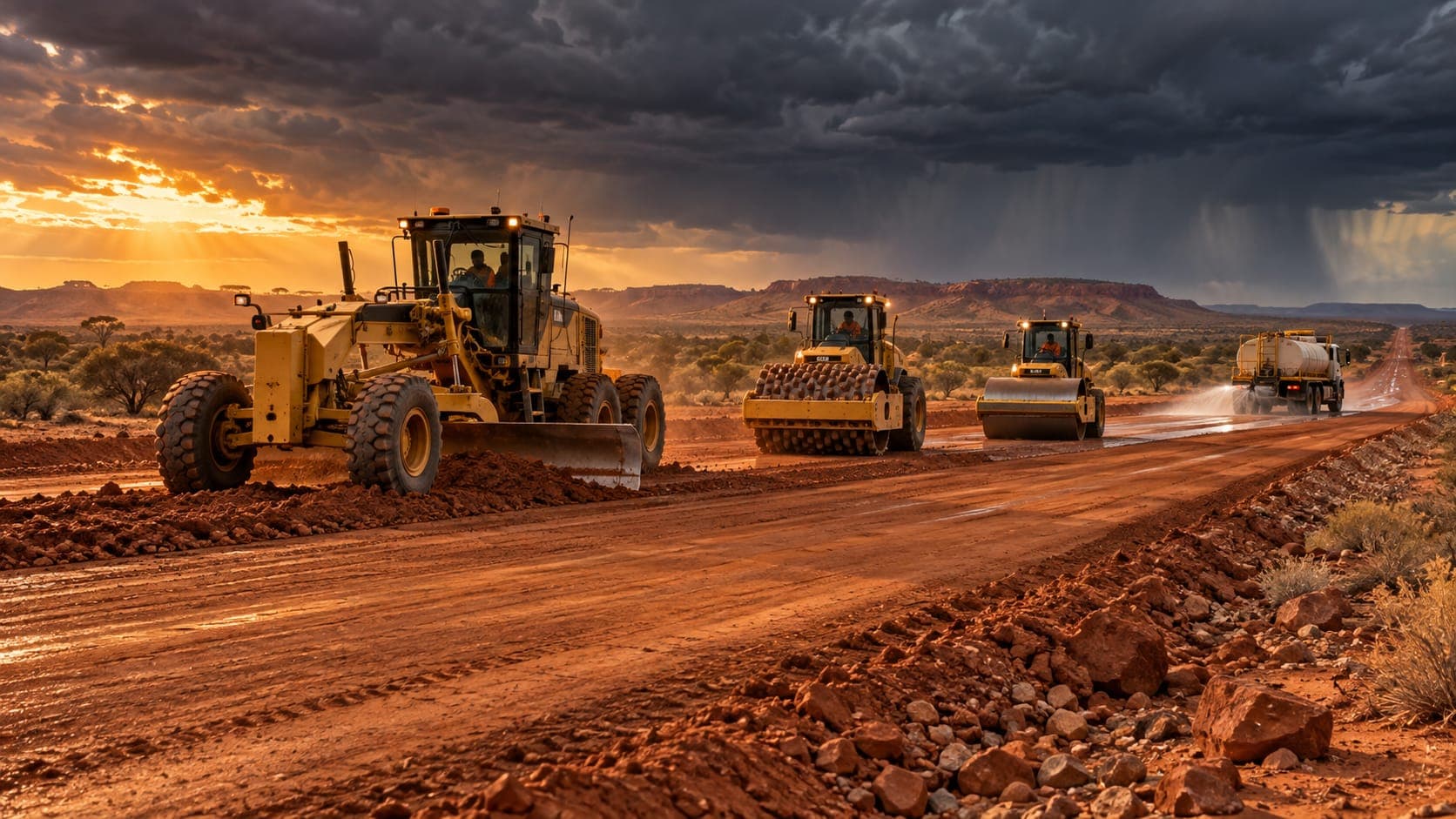
A rural highway upgrade in Australia commonly runs: 30–36 tonne excavators and ADTs or truck-and-dog combinations for bulk earthworks; D6- and D8-class dozers for clearing and spreading; two or more 12–14 class graders for formation and pavement trim with GPS machine control; 12–20 tonne pad-foot and smooth-drum rollers; multi-tyred rollers for final pavement and sealing; 13–15 kL water carts; and a stabiliser with spreader truck where lime or cement stabilisation is specified. Surfacing crews — sprayed seal or asphalt — are usually specialist subcontractors with their own plant.
Night works on urban arterials change the fleet mix: smaller, quieter machines, more lighting towers, shorter production windows and more support vehicles. Expect higher hourly costs and plan for lower output per shift.
Traffic management under AGTTM
Most states now apply the Austroads Guide to Temporary Traffic Management (AGTTM), with state-specific supplements and qualification requirements. The traffic guidance scheme sets where plant can enter and leave the work zone, speed limits, and whether truck-mounted attenuators are required. Plant suppliers do not normally design traffic management, but their operators must follow it, so share the approved schemes with every supplier before mobilisation.
Illustrative scenario: a regional highway overtaking lane
A 3 km overtaking lane on a regional highway in Queensland involves widening an existing road, new drainage and a granular pavement with a sprayed seal. Traffic stays open throughout under a reduced speed zone.
The contractor plans bulk earthworks with a 30-tonne excavator and truck-and-dog combinations, a D6 dozer and pad-foot roller; drainage with a 20-tonne excavator; pavement with two graders on machine control, a smooth-drum roller, a multi-tyred roller and two water carts; and a sealing subcontractor. Traffic management includes a truck-mounted attenuator for work adjacent to the live lane. The plant schedule shows each machine's start and finish week so hire costs match the construction sequence.
Sample supplier brief
A short written brief gets faster, more comparable quotes. Adapt this example to your job:
“We require two 12–14 class graders with 3D machine control, a 12-tonne smooth-drum roller, a multi-tyred roller and two 13 kL water carts, wet hire, for pavement construction on a 3 km highway widening near Dubbo, NSW. Work is under Transport for NSW specifications, in a reduced speed zone next to live traffic, day shift only.”
“Duration is about 10 weeks from mid-April. Please include rates, minimum hours, wet-weather standby terms, float costs and operator experience with live-traffic work.”
Common questions
Which roller do I need for pavement work?
It depends on the material and layer. Pad-foot rollers suit cohesive subgrades, smooth-drum vibrating rollers suit granular pavements, and multi-tyred rollers are used for finishing and sealing. Check the specification and ask the supplier.
Do roadworks need wet or dry hire?
Specialist units like profilers, stabilisers and pavers are commonly wet hired with experienced crews. General plant such as rollers and water carts is often dry hired by contractors with their own operators.
What should a paving enquiry include?
Material type, width, compacted depth, tonnage per shift, working windows, access, traffic control and the quality specification.
How long does road plant need to be on site?
It depends on the stage. Earthworks plant may leave once formation is complete, while graders, rollers and water carts continue through the pavement stage. Schedule each machine to its stage to avoid paying for idle plant.
This guide is general information to help you prepare a better enquiry. It is not engineering, legal or safety advice. Equipment selection, engineering and safe systems of work remain the responsibility of competent project and supplier teams, and regulatory requirements differ between states and sites.