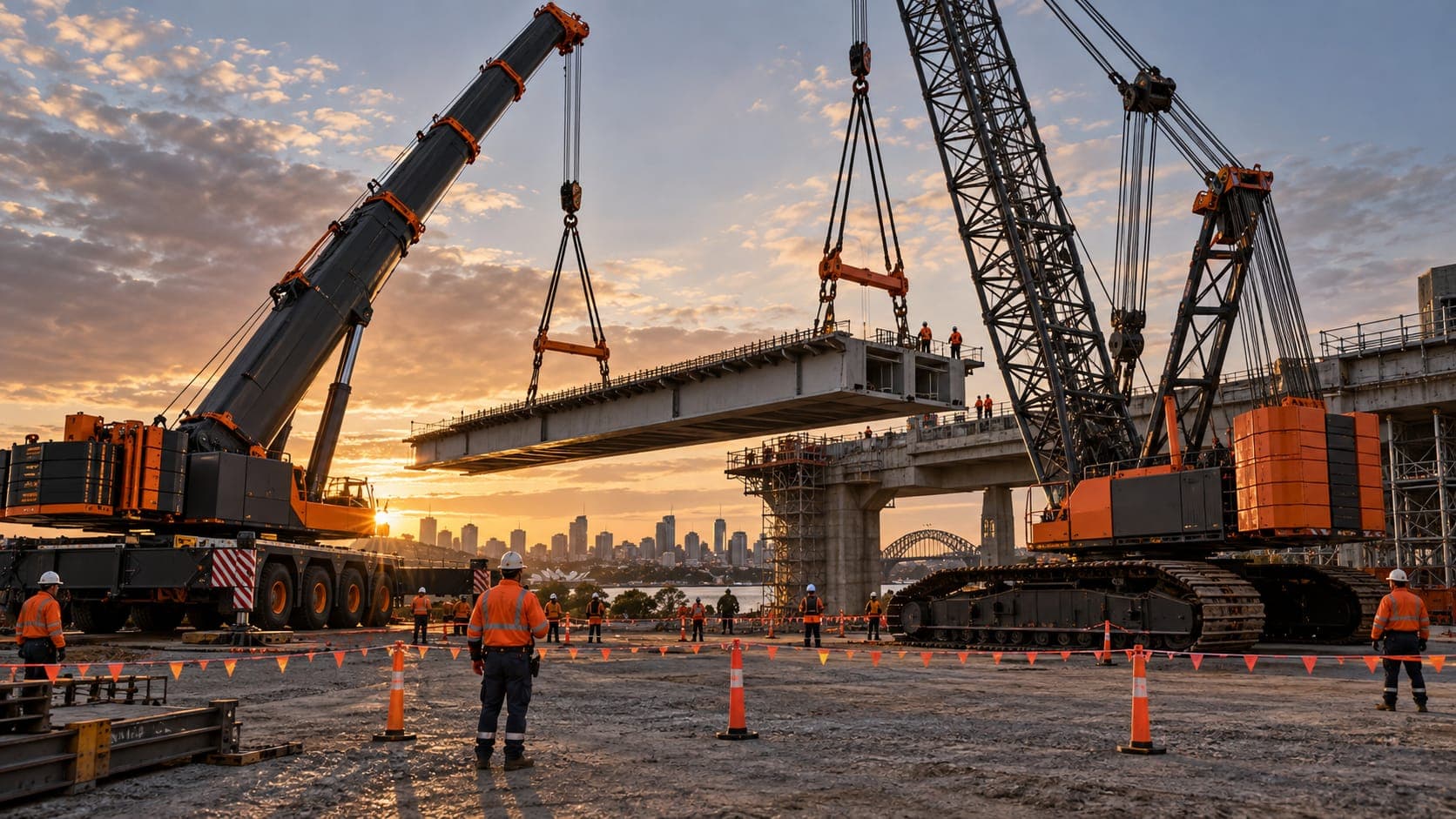
A lift is usually called critical when the load is heavy relative to the crane's capacity, when more than one crane is involved, when the load is lifted over people, live plant or public areas, or when the consequence of failure is severe. Each principal contractor defines it in its own procedures. This guide covers the information a crane supplier needs to quote safely and how to avoid last-minute changes on lift day.
Editorial planning guidance with illustrative scenarios. No independent professional review is claimed. Read the authorship and evidence policy or report a correction.
Verified load data comes first
The load weight must be verified, not estimated. Use manufacturer data, a weighbridge certificate or engineering calculation, and add the weight of the rigging, spreader beams, hook block and any temporary attachments. Identify the centre of gravity and lifting points. An unknown or shifting centre of gravity can make a lift critical by itself.
Radius, height and the crane configuration
Crane capacity depends on radius, boom length, counterweight and outrigger set-up, not the nominal tonnage on the side of the crane. A 100-tonne crane may only lift a small fraction of that at the radius your site allows. Provide a site plan with the crane position, pick point, set-down point and obstructions so the supplier can run the load charts.
Consider the whole slew path. Power lines, buildings, trees and other cranes can force a longer radius or a larger crane than the pick itself suggests.
Ground bearing and set-up
Outrigger and crawler track loads during a heavy lift can be very high. The crane supplier can calculate the loads; the site needs to confirm the ground can take them. That may mean geotechnical advice, a designed crane pad, or engineered mats. Underground services, basements, pits and recently backfilled trenches near the set-up area must be identified.
Large mobile and crawler cranes also need space and access for assembly, counterweight delivery and support cranes. Include that footprint in the site plan.
The lift team and documentation
Crane operation, dogging and rigging are high-risk work licence classes in Australia. Confirm who provides the crane operator, dogman or rigger, and who prepares the lift plan. For critical lifts, many principals require a lift study signed off by an engineer, a pre-lift meeting and a permit. Ask for the crane's current inspection records and major inspection status.
- Crane operator with the correct licence class
- Dogger or rigger for slinging and directing
- Lift plan or engineered lift study
- Wind speed limits and a weather check procedure
Exclusion zones, permits and traffic
Road closures, council permits, footpath occupation and traffic control can have lead times of weeks. If the crane travels on public roads, oversize movement permits and escorts may be needed. Plan the exclusion zone for the load path and set-up area, and who will enforce it.
Australian crane types and what they suit
Pick-and-carry cranes (often called Frannas after the best-known brand) in the 20–40 tonne range are Australia's most common site crane. They travel on road, set up without outriggers and can carry loads short distances, but their capacity drops quickly with radius and on slopes, and they are prone to tip-over if carried loads, gradients or articulation are not controlled. City cranes and all-terrain cranes from 50 to 500 tonnes or more cover heavier and longer-radius lifts. Crawler cranes suit long-duration, heavy work such as bridge beams and wind turbines, but need assembly space and transport of many loads.
For critical lifts, the crane choice is normally driven by the heaviest pick at the longest radius, plus a margin required by the principal's lifting procedures. Many principals set a maximum percentage of rated capacity — commonly in the 75–85% range — beyond which a lift is automatically classed as critical and needs an engineered lift study. Check your principal's threshold.
Licences for the lift team
Operators and doggers or riggers must hold the correct high-risk work licence class. For a pick-and-carry crane the operator needs a CN licence; a 55 tonne slewing crane needs C6 or higher; a 100 tonne crane needs C1 or C0. Slinging and directing loads out of the operator's view requires a dogging (DG) licence, and rigging work requires the relevant RB, RI or RA class. Ask the supplier for copies of licences for the named crew before the lift.
| Licence | Covers |
|---|---|
| CN | Non-slewing mobile crane over 3 t (e.g. pick-and-carry cranes) |
| C2 | Slewing mobile crane up to 20 t |
| C6 | Slewing mobile crane up to 60 t |
| C1 | Slewing mobile crane up to 100 t |
| C0 | Slewing mobile crane, open (any capacity) |
| CV | Vehicle loading crane of 10 metre-tonnes or more |
| WP | Boom-type elevating work platform, boom 11 m or more |
| LF | Forklift truck |
| DG | Dogging |
| RB / RI / RA | Rigging basic, intermediate and advanced |
Indicative crane costs
Crane hire in Australia is nearly always wet hire and charged hourly with a minimum call-out. For a critical lift, budget for more than crane time: a lift study or engineered plan, site inspection, extra rigging crew, transport of counterweights for larger cranes, traffic control, permits and possible standby while weather or site readiness is confirmed.
| Crane | Project quote |
|---|---|
| Pick-and-carry (Franna-type) 20–25 t | Request a project-specific written quote |
| Pick-and-carry 40 t | Request a project-specific written quote |
| City or all-terrain 50–60 t | Request a project-specific written quote |
| All-terrain 100 t | Request a project-specific written quote |
| All-terrain 200–250 t | Request a project-specific written quote |
| Dogman or rigger (additional) | Request a project-specific written quote |
Illustrative scenario: replacing a rooftop plant unit
A hospital in Melbourne needs a 9-tonne air-handling unit lifted onto a roof 30 metres high, at a 28-metre radius from the only available crane position in a loading dock. Because the load passes over an occupied building, the principal classifies it as a critical lift.
The crane company runs load charts and proposes a 200-tonne all-terrain crane, which keeps the lift below the principal's capacity threshold at that radius. An engineer checks the dock slab for outrigger loads and specifies mats. The lift happens early on a Sunday with a road closure permit from council, traffic control, a rigging crew and a wind limit agreed in advance. The pre-lift meeting confirms roles, communication and the abort criteria.
Sample supplier brief
A short written brief gets faster, more comparable quotes. Adapt this example to your job:
“We need a crane and lift crew to place a 9.2-tonne verified load (plus rigging) onto a roof at 30 m height and 28 m radius from a loading dock in inner Melbourne. The site plan, dock slab drawings and load data sheet are attached. The lift passes over an occupied building and is classed as critical under our procedures.”
“Please propose a crane, confirm the percentage of rated capacity, provide outrigger loads and mat requirements, the lift plan or study you will supply, crew licences, and all costs including permits, counterweight transport and standby. Preferred lift date is a Sunday in May.”
Common questions
Can I select a crane from load weight alone?
No. Radius, boom length, lift height, counterweight, outrigger set-up and ground conditions all change the crane's available capacity.
What is the difference between dry and wet crane hire?
In Australia most crane hire is wet (operated) hire, where the supplier provides the crane and a licensed operator. Dry hire is uncommon for larger cranes.
Who prepares the lift plan?
It varies. Crane companies often prepare lift plans or studies, but the principal contractor remains responsible for the overall safe system of work. Agree this in writing.
What wind speed stops a crane lift?
The limit depends on the crane manufacturer's data, the load's surface area and the lift plan. Many lifts set a lower limit than the crane's maximum for large or light loads that catch wind.
This guide is general information to help you prepare a better enquiry. It is not engineering, legal or safety advice. Equipment selection, engineering and safe systems of work remain the responsibility of competent project and supplier teams, and regulatory requirements differ between states and sites.